IoT in agriculture
IoT in agriculture-How IoT & Drones Cut Farm Water & Fertilizer Waste by 30% : For decades, modern agriculture relied on blanket applications. If a corner of a 50-acre plot appeared parched or yellowing, the tractor rolled out to irrigate or fertilize the entire field.
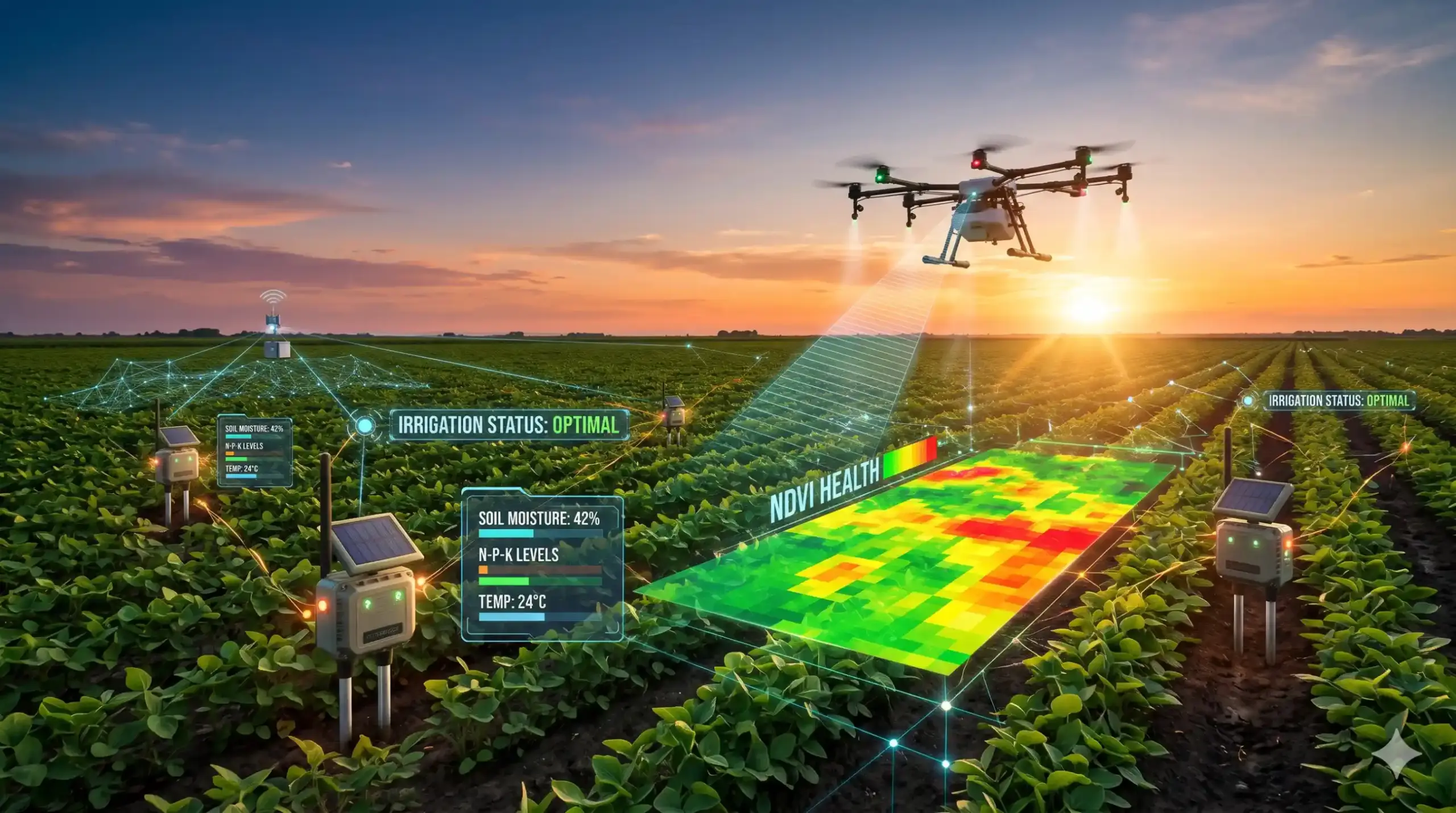
Today, rising input costs, tighter margins, and volatile weather patterns have made blanket farming unsustainable. Fortunately, the barrier to entry for precision agriculture has fallen rapidly. Through connected sensors, automated telemetry, and multispectral drone imagery, farmers are moving from guesswork to pin-point accuracy—slashing water and chemical fertilizer usage by up to 30% without sacrificing yields.
1. Soil Moisture Telemetry: Moving Beyond Calendar Irrigation
The traditional method of irrigating on a fixed weekly schedule ignores actual soil hydration dynamics. Fixed timers often run during unexpected rain events or fail to account for differing soil textures across a single plot (such as sandy loam draining twice as fast as clay patches).
How IoT Changes the Formula
- Capacitance Probes at Multiple Depths: Modern probes monitor volumetric water content (VWC) at 10 cm, 20 cm, and 40 cm underground. This reveals not just surface moisture, but whether water is actually reaching the active root zone.
- Automated Solenoid Valves: By pairing soil sensors with low-power wide-area networks (such as LoRaWAN or NB-IoT), irrigation pumps switch on only when root-zone moisture dips below field capacity.
- Real-World Impact: Eliminates deep percolation losses (water draining past roots where crops cannot use it) and prevents root rot, saving 20% to 35% of total water volume per cycle.
2. Multispectral Drones: Seeing Crop Stress Before the Human Eye Can
By the time nitrogen deficiency or water stress causes visible chlorosis (leaf yellowing), irreversible cellular damage has already reduced potential harvest weight.
Multispectral sensors mounted on lightweight drones capture reflected light across red-edge and near-infrared (NIR) wavelengths.
| Metric / Index | What It Detects | Traditional Method | AgTech Advantage |
| NDVI (Normalized Difference Vegetation Index) | Overall plant vigor & canopy density | Walking rows / visual inspection | Maps an entire 100-acre field in under an hour |
| NDRE (Normalized Difference Red Edge) | Chlorophyll content in dense/mature crops | Destructive leaf-tissue laboratory sampling | Detects nitrogen depletion 7–10 days before visible yellowing |
| Thermal Infrared | Transpiration rates & canopy temperature | Soil touch / subjective estimate | Spots clogged drip emitters or root choke before wilting begins |
With georeferenced NDVI and NDRE maps, farmers export variable-rate prescription files straight into modern tractor terminals, applying top-dress fertilizer only to the specific zones requiring nutrition.
3. The Payback Window: Calculating ROI for Midsize Farms
One persistent misconception is that IoT and precision agriculture are reserved exclusively for mega-operations with six-figure tech budgets. In reality, modern modular hardware significantly shortens the return on investment (ROI).
Example Payback Model (50–100 Acre Setup)
- Initial Setup Cost: ~$2,500 – $4,500
- LoRaWAN base station (gateway)
- 4–6 multi-depth soil moisture & electrical conductivity (EC) sensor nodes
- Commercial inspection drone with multispectral camera (or third-party scouting service subscription)
- Direct Input Reductions:
- Water/Electricity: 25% lower pumping hours cuts diesel or electric utility bills directly.
- Nitrogen (Urea/UAN): 20% reduction through precision spot application instead of uniform broadcasts.
- Average Payback Period: Most growers of high-value crops (orchards, vineyards, specialty vegetables) recoup total equipment costs within 1 to 2 growing seasons through input savings alone, excluding yield gains.
4. How to Get Started Without Overwhelming Your Operation
If you are evaluating IoT integration for the coming season, avoid trying to automate everything on day one. A measured approach yields the best adoption rate:
- Conduct an Elevation & Soil Texture Audit: Identify your field’s natural stress zones—where water puddles and where soil dries out first.
- Deploy Pilot Nodes: Install 2 to 3 moisture sensors in contrasting zones (your best-performing vs. worst-performing sections) to establish a baseline.
- Automate Alerting First, Actuation Second: Begin by using telemetry for notifications (e.g., SMS alerts when root moisture drops below threshold) before investing in fully automated valve shutoffs.
Key Takeaway
Precision farming is no longer about novelty gadgets—it is about resource efficiency. By pairing root-level soil telemetry with aerial crop-health indexing, farmers can safeguard margins against rising input costs while keeping topsoil and water tables healthy for future seasons.
- IoT in agriculture-How IoT & Drones Cut Farm Water & Fertilizer Waste by 30%
- Indian Maize Market Price Forecast 2026–27: Fundamental Analysis, Technical Trends, El Niño Impact and Six-Month Price Outlook
- How to Book Urea & Fertilizers in the Framework for Fertilizer Sale (FFS) App: Step-by-Step Guide
- Framework for Fertilizer Sale (FFS): Telangana’s New Centralized Fertilizer App
- Fertilizer Booking App: Mistakenly Entered Less Crop Area? Here’s What Farmers Need to Know