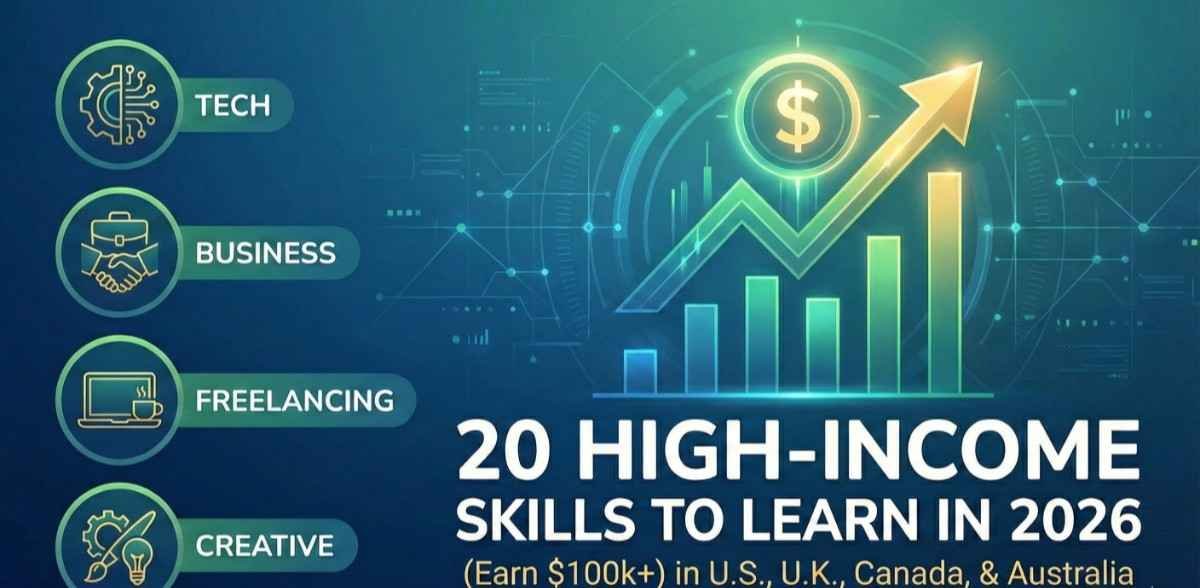
High-Income Skills 2026
High-Income Skills 2026.The landscape of work is shifting beneath our feet. As we move further into 2025, the gap between “average” and “high-income” earners is no longer defined by degrees or decades of tenure, but by specific, leverageable capabilities.
Whether you are a corporate climber, a freelancer, or an aspiring entrepreneur, mastering high income skills is the most reliable path to financial freedom. In major markets like the U.S., U.K., Canada, and Australia, professionals armed with these specific tools are commanding salaries well over $100k+ (and their local equivalents).
If you are ready to future-proof your career, here is your definitive guide to the most valuable skills to learn in 2025.
What Makes a Skill “High-Income”?
Not all skills are created equal. In 2025, a skill is considered “high-income” if it meets three specific criteria:
- High Leverage: The skill directly impacts revenue or saves the company significant money. If your work brings in $1 million, paying you $150,000 is a bargain.
- Scarcity: There is a gap between market demand and the supply of qualified talent.
- Difficulty to Automate: While AI can write basic emails, it cannot yet architect a complex cloud infrastructure or close a six-figure B2B enterprise deal.
Top 20 Skills (Ranked)
Below are the top 20 skills for 2025, categorized by industry. These rankings are based on current salary data, job growth projections, and freelance rate trends.
Tech
The highest salary ceilings in 2025 are found here. Tech skills are the backbone of the modern economy.
1. Artificial Intelligence (AI) & Machine Learning
The undisputed king of 2025. Companies are scrambling to integrate AI into their products.
- Why it pays: You aren’t just coding; you are building systems that learn and automate.
- Key Focus: Natural Language Processing (NLP), Generative AI (LLMs), and Computer Vision.
- Potential Income: $150k – $250k+
2. Cloud Computing Architecture (AWS/Azure)
Businesses are moving everything to the cloud. They need architects to design secure, scalable server environments.
- Why it pays: A bad cloud setup costs millions in downtime. A good one saves millions in efficiency.
- Key Focus: AWS Certified Solutions Architect, Microsoft Azure, Google Cloud Platform.
3. Cybersecurity & Ethical Hacking
As cyber threats grow more sophisticated, the defenders become more valuable.
- Why it pays: Security breaches destroy reputations. Companies pay a premium for “insurance” in the form of skilled talent.
- Key Focus: Network security, penetration testing, CISSP certification.
4. Data Science & Analytics
Data is the new oil, but it’s useless unrefined. Data scientists turn raw numbers into actionable business strategy.
- Why it pays: You provide the “why” and “how” behind major business decisions.
- Key Focus: Python, R, SQL, Tableau, Predictive Analytics.
5. Blockchain Development
Beyond crypto, blockchain is revolutionizing supply chains and secure contracts (Smart Contracts).
- Why it pays: Extremely niche talent pool with high technical barriers to entry.
- Key Focus: Solidity, Ethereum, Rust, Smart Contract Security.
6. DevOps Engineering
The bridge between coding (Dev) and operations (Ops). DevOps engineers ensure software is released smoothly and frequently.
- Why it pays: They increase the speed of innovation for the entire company.
- Key Focus: Docker, Kubernetes, CI/CD pipelines (Jenkins/GitLab).
7. Full Stack Software Development
The ability to build both the front-end (what users see) and back-end (logic and database) of an application.
- Why it pays: Versatility. Startups and tech giants alike value developers who can “do it all.”
- Key Focus: React, Node.js, Python, MERN Stack.
8. Mobile App Development
With the world being mobile-first, high-quality iOS and Android developers remain in critical demand.
- Why it pays: Direct channel to consumers.
- Key Focus: Swift (iOS), Kotlin (Android), Flutter/React Native (Cross-platform).
Business
You don’t need to code to earn six figures. These skills drive growth, strategy, and operations.
9. Digital Marketing (SEO/SEM)
Driving traffic is the lifeblood of business. Experts who can rank websites (SEO) or manage profitable ad spend (SEM) are invaluable.
- Why it pays: Directly tied to revenue generation.
- Key Focus: Google Ads, Technical SEO, Programmatic Advertising.
10. Project Management (Technical & Agile)
Keeping complex teams organized and on track.
- Why it pays: Inefficiency kills projects. PMP or Agile certified managers ensure products actually launch.
- Key Focus: PMP, Scrum Master, Agile Methodologies, Jira.
11. Technical Sales (SaaS)
Selling complex software to other businesses.
- Why it pays: High base salary + uncapped commissions. This is often the fastest route to $100k+ without a technical degree.
- Key Focus: Lead generation, CRM management (Salesforce), closing strategies.
12. Product Management
The “CEO of the product.” You decide what features to build based on user needs and business goals.
- Why it pays: You sit at the intersection of business, tech, and design.
- Key Focus: Product roadmap strategy, user research, agile workflow.
13. Financial Analysis & Consulting
Helping companies manage cash flow, investments, and risk.
- Why it pays: Financial health is non-negotiable for business survival.
- Key Focus: Financial modeling, risk assessment, CPA/CFA paths.
14. Business Operations (BizOps)
Optimizing the internal “machine” of a company to run faster and cheaper.
- Why it pays: Directly improves the bottom line by reducing waste.
- Key Focus: Automation tools, workflow optimization, supply chain management.
Freelancing
Skills specifically suited for the “gig economy” that allow you to scale your income independently.
15. Direct Response Copywriting
Writing words that sell. Unlike content writing (which informs), this skill is about persuasion.
- Why it pays: A single sales letter or email sequence can generate millions. Copywriters get paid a premium (or royalties) for this result.
- Key Focus: Sales funnels, email marketing, landing page copy.
16. Web Design & Development (No-Code/Low-Code)
Building high-converting websites for small businesses using tools like Webflow, Shopify, or WordPress.
- Why it pays: Every local business needs a digital storefront.
- Key Focus: UX principles, conversion rate optimization (CRO), Webflow.
17. Specialized Consulting
Packaging your specific industry knowledge (e.g., “HR for Remote Teams” or “Sustainability Compliance”) into a service.
- Why it pays: Companies pay for speed and certainty.
- Key Focus: Niche expertise, personal branding.
Creative
Where art meets commerce. These skills are highly paid when applied to business growth.
18. UX/UI Design
Designing the look and feel of apps to ensure they are intuitive and addictive.
- Why it pays: Good design retains users; bad design repels them.
- Key Focus: Figma, Adobe XD, User Research, Wireframing.
19. Video Editing & Motion Graphics
Video is the primary language of the internet in 2025 (YouTube, TikTok, Instagram Reels).
- Why it pays: High retention content is critical for marketing.
- Key Focus: Adobe Premiere Pro, After Effects, DaVinci Resolve.
20. Content Strategy
Not just creating content, but planning what to create to achieve business goals.
- Why it pays: Companies are drowning in noise; strategists help them cut through it.
- Key Focus: Audience analysis, brand storytelling, analytics.
How to Learn These Skills
You do not need to go back to university for 4 years. In 2025, speed of implementation is key.
- Online Certifications: Platforms like Coursera and edX offer professional certificates from Google, IBM, and Meta.
- Top Pick: Google Data Analytics Certificate or AWS Certified Solutions Architect.
- Bootcamps: Intensive 12-24 week programs for coding, UI/UX, and data science.
- Self-Taught Portfolios: For creative and freelance skills (Copywriting, Video Editing), your portfolio matters more than a certificate. Build real projects for free to start, then charge as you improve.
Jobs You Can Get
Acquiring these high-income skills opens doors to prestigious roles. Here is a quick mapping of skills to job titles:
| Skill Category | Potential Job Titles | Est. Salary (USD) |
| Tech | AI Engineer, Cloud Architect, DevOps Manager | $130k – $200k+ |
| Business | Digital Marketing Director, SaaS Account Executive, Product Manager | $100k – $180k+ |
| Freelancing | Freelance Copywriter, Shopify Developer, Fractional CMO | $50/hr – $250/hr |
| Creative | Senior Product Designer, Lead Video Editor, Creative Director | $90k – $150k+ |
FAQs
1. Which high-income skill is easiest to learn?
For non-technical people, Digital Marketing or Copywriting are often the most accessible entry points. They require creativity and psychology rather than advanced math or coding.
2. Can I learn these skills part-time?
Absolutely. Most successful career switchers start by dedicating 10-15 hours a week to online courses while keeping their current job.
3. Are these skills relevant in the UK, Canada, and Australia?
Yes. While the salary numbers (e.g., $100k) might be in USD, the purchasing power and “high income” status translate directly. An AI Engineer in London or Toronto is still a top-tier earner relative to the local economy.
4. Will AI replace these skills?
AI will enhance these skills, not replace them. A copywriter who uses AI writes faster. A developer who uses AI codes faster. The “high income” earner of 2025 is the person who knows how to use AI to do the work of ten people.
Next Step: Choose one skill from the list above that interests you today. Do not overthink it—spend 30 minutes researching the top-rated Coursera course or YouTube tutorial for that specific skill and bookmark it.
Read more
- How to Book Urea & Fertilizers in the Framework for Fertilizer Sale (FFS) App: Step-by-Step Guide
- Framework for Fertilizer Sale (FFS): Telangana’s New Centralized Fertilizer App
- Fertilizer Booking App: Mistakenly Entered Less Crop Area? Here’s What Farmers Need to Know
- Monsoon 2026: Best Crops for Farmers as IMD Predicts Weak Rainfall
- Digital India: Identify Your Land Survey Number Instantly Using Your Smartphone






Comments are closed.