What Is a Credit Score? How It Works
What Is a Credit Score? How It Works. In the modern financial world, three digits define much of your life’s potential. They can determine whether you drive a new car or a clunker, whether you rent a luxury apartment or struggle to find a lease, and—perhaps most importantly—how much you pay for the privilege of borrowing money.
So, what is a credit score, exactly?
At its core, a credit score is a numerical expression of your creditworthiness. It is a statistical analysis based on your credit files, representing the likelihood that you will pay your bills on time. Think of it as a “financial report card” for adults. Lenders, landlords, and even insurers look at this number to gauge risk. A high score tells them you are a safe bet; a low score suggests you might be a financial risk.
As we move through 2025, the algorithms used to calculate these scores are becoming smarter and more integrated, but the fundamental rules remain the same. Whether you are in the US, UK, Canada, or Australia, understanding this number is the first step toward financial freedom.
What Affects Your Credit Score?
Many people believe their income, age, or employment status directly dictates their credit score. This is a myth. While those factors affect loan approval, your actual credit score is derived strictly from the data found in your credit report.
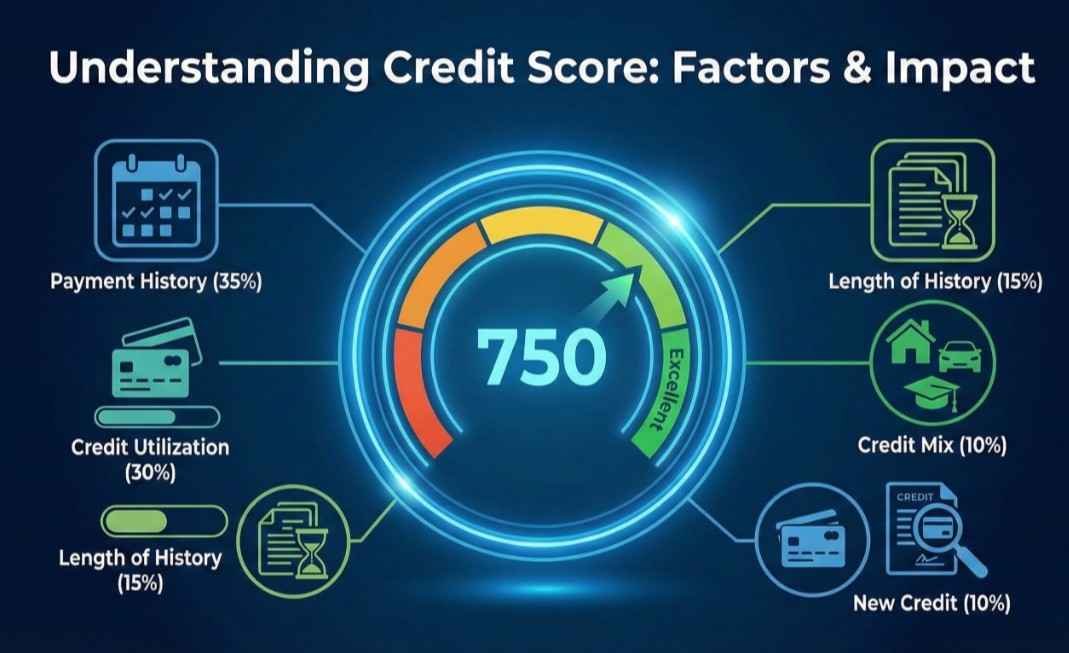
While different models (like FICO® or VantageScore®) weigh factors slightly differently, the general breakdown of what impacts your score includes these five pillars:
1. Payment History (35% Impact)
This is the single most significant factor. Lenders want to know: Have you paid your past credit accounts on time?
- Positive: A long history of on-time payments.
- Negative: Late payments (30+ days), collections, bankruptcies, or foreclosures. Even one missed payment can drop a high score by over 100 points.
2. Credit Utilization Ratio (30% Impact)
This refers to the amount of credit you are using compared to your credit limits.
- ** The Math:** If you have a credit card with a $10,000 limit and a $5,000 balance, your utilization is 50%.
- The Golden Rule: Financial experts recommend keeping this ratio below 30%. The lower your utilization, the better your score, as it shows you aren’t over-reliant on borrowed money.
3. Length of Credit History (15% Impact)
Lenders like to see a long track record. This factor considers the age of your oldest account, the age of your newest account, and the average age of all accounts.
- Tip: This is why you should generally avoid closing old credit card accounts, even if you don’t use them often. That history is valuable.
4. Credit Mix (10% Impact)
Scoring models reward consumers who can handle different types of credit successfully. A healthy mix includes:
- Revolving Credit: Credit cards, lines of credit.
- Installment Loans: Mortgages, auto loans, student loans.
5. New Credit (10% Impact)
Every time you apply for a loan or credit card, a “hard inquiry” is placed on your report. Opening several accounts in a short time represents greater risk, especially for people with short credit histories.
US vs UK vs CA vs AU Scoring Systems
While the concept of a credit score is universal, the scoring ranges and bureaus differ significantly by country. Here is how the major English-speaking markets compare in 2025.
United States 🇺🇸
In the US, the most commonly used score is the FICO® Score, though VantageScore is gaining popularity.
- Range: 300 to 850.
- Key Bureaus: Equifax, Experian, TransUnion.
- Good Score: Generally, anything above 700 is considered good. A score above 800 is exceptional, unlocking the absolute best interest rates.
United Kingdom 🇬🇧
The UK does not have a universal score. Lenders use their own internal scoring systems combined with data from the bureaus.
- Range: Differs by bureau.
- Experian: 0–999
- Equifax: 0–1000
- TransUnion: 0–710
- Key Insight: Because there is no single “magic number,” you might be rejected by one bank and accepted by another on the same day.
Canada 🇨🇦
Canada’s system closely mirrors the US, utilizing the FICO model (often called the Beacon score).
- Range: 300 to 900.
- Key Bureaus: Equifax and TransUnion.
- Good Score: A score of 660+ is generally considered acceptable, while 760+ is excellent.
Australia 🇦🇺
Australia has moved towards “Comprehensive Credit Reporting” (CCR), meaning positive behaviors (paying on time) are now recorded alongside negative ones.
- Range: Usually 0 to 1,000 or 0 to 1,200 depending on the bureau.
- Key Bureaus: Equifax, Experian, illion.
- Good Score: A score above 622 (Equifax) is generally considered good.
Why Credit Score Matters
You might wonder, “If I pay with cash, why does this number matter?” In 2025, your credit score influences far more than just credit cards. It is a metric of your reputation.
1. Lower Interest Rates
This is the most tangible benefit. On a 30-year mortgage, the difference between a credit score of 620 and 760 can translate to tens of thousands of dollars in interest savings. A high score literally puts money back in your pocket.
2. Loan Approval Chances
Before a bank discusses rates, they must decide if they will lend to you at all. A poor score can lead to immediate rejection for mortgages, auto loans, and personal loans.
3. Housing Rentals
Landlords almost always run credit checks. In competitive rental markets, a high credit score can be the deciding factor between you and another applicant getting the keys to an apartment.
4. Insurance Premiums
In many US states and varying global jurisdictions, auto and home insurers use “credit-based insurance scores” to set premiums. Statistics show a correlation between lower credit scores and higher insurance claims, meaning a lower score could double your insurance bill.
5. Utility Services
Utility companies (electricity, water, internet) check credit to determine if you need to pay a security deposit. A good score often waives these upfront costs.
How to Check Your Credit Score
Ignorance is not bliss when it comes to credit. You need to know where you stand. Fortunately, checking your own score is easier than ever and does not hurt your credit.
Free Annual Reports
In the US, federal law allows you to get a free copy of your credit report every 12 months from each credit reporting company at AnnualCreditReport.com. Similar legislations exist in the UK, Canada, and Australia.
Credit Monitoring Services
Apps like Credit Karma, ClearScore, or Borrowell provide free weekly updates on your score. These services usually show your VantageScore (or equivalent) rather than FICO, but they are excellent for tracking trends.
Banking Apps
Most major banks now offer a “FICO Score Dashboard” directly inside their mobile banking apps for free. This is often the most accurate way to see what lenders see.
Note: Checking your own score is known as a Soft Inquiry. It has zero impact on your score. Only “Hard Inquiries” (made by lenders when you apply for credit) impact your score.
How to Improve Credit Score
If your score isn’t where you want it to be, don’t panic. Credit scores are dynamic. They change as your financial behavior changes. Here is a strategic roadmap to improve your credit score:
1. Pay Your Bills on Time, Every Time
Set up automatic payments for at least the minimum amount due. This ensures you never miss a payment deadline. Consistency is key here; a few months of on-time payments can start to heal past damage.
2. Pay Down Revolving Debt (The 30% Rule)
High credit card balances hurt your score the most. Create a plan to pay down credit cards.
- Strategy: If you can’t pay the balance off, try to request a credit limit increase without spending more. This mathematically lowers your utilization ratio.
3. Don’t Close Old Accounts
As mentioned earlier, credit age matters. If you have an old credit card with no annual fee, keep it open. Buy a cup of coffee on it once every six months to keep it active. Closing it shortens your credit history and lowers your available credit, both of which hurt your score.
4. Dispute Errors
Credit reports often contain mistakes—wrong addresses, accounts that aren’t yours, or payments marked late that were actually on time. Review your report closely. If you find an error, file a dispute with the credit bureau immediately. This is the fastest way to get an artificial boost.
5. Diversify Your Credit
If you only have credit cards, consider a small credit-builder loan. This adds an “installment loan” to your mix, showing lenders you can handle different types of debt.
Checklist: How to Dispute Credit Report Errors
Errors on credit reports are surprisingly common. A study by the FTC found that 1 in 5 people have an error on at least one of their credit reports. Use this step-by-step checklist to find and fix mistakes that could be dragging your score down.
Phase 1: The Investigation
- [ ] Download your reports.
- Go to AnnualCreditReport.com (US) or the equivalent agency in your country.
- Download reports from all three major bureaus: Equifax, Experian, and TransUnion. (They don’t share data instantly, so an error might only appear on one).
- [ ] Verify Personal Information.
- [ ] Is your name spelled correctly?
- [ ] Is your current and past address correct?
- [ ] Is your Social Security Number (or SIN/NI number) correct?
- [ ] Review Account Statuses.
- [ ] Are closed accounts marked as “Closed”?
- [ ] Are accounts you paid in full marked as “Paid in Full”?
- [ ] Are there any accounts listed as “Late” or “Delinquent” that you know you paid on time?
- [ ] Check for Duplicate Accounts.
- [ ] Does the same debt appear twice? (Sometimes happens when a debt is sold to a collector).
- [ ] Look for Fraud.
- [ ] Are there accounts or inquiries you generally do not recognize? (This could be a sign of identity theft).
Phase 2: Gathering Evidence
- [ ] Highlight the error.
- Print your report and circle the specific item in question.
- [ ] Collect proof.
- Gather bank statements, cancelled checks, or payment confirmation emails that prove you paid on time or paid off the debt.
- Crucial Rule: Never send originals. Only send copies.
Phase 3: Filing the Dispute
- [ ] Choose your method.
- Online: Faster, but sometimes limits your ability to upload complex evidence or keeps less of a paper trail.
- Certified Mail: Slower, but highly recommended by legal experts because it provides proof of receipt.
- [ ] Write your dispute letter.
- Clearly identify each item you are disputing.
- State the facts and explain why it is wrong (e.g., “This account was closed by consumer,” or “I was never late on this date”).
- Request that it be removed or corrected.
- [ ] Send to the Bureaus.
- If the error is on all three reports, you must file a separate dispute with each bureau (Equifax, Experian, TransUnion).
- [ ] Send to the Data Furnisher (Optional but Recommended).
- Send a copy of the dispute to the actual company (e.g., the bank or credit card issuer) that reported the error.
Phase 4: The Follow-Up
- [ ] Wait 30-45 Days.
- The bureaus legally have 30 to 45 days to investigate.
- [ ] Review the Results.
- They will send you a summary of the investigation.
- If corrected: They will send you a new, free copy of your report.
- If denied: They will explain why. You may need to provide more specific evidence and dispute it again.
- [ ] Check your Score.
- Once the error is removed, check your score after the next billing cycle to see the improvement!
Credit report Dispute letter template Download
DownloadFAQs
What is considered a “good” credit score?
While it varies by model, a score between 670 and 739 is generally considered “Good” in the US. A score of 740 to 799 is “Very Good,” and 800+ is “Exceptional.”
How often does my credit score update?
Your score changes whenever your credit report data changes. Generally, creditors report to bureaus once a month (usually on your statement closing date). Therefore, your score typically updates effectively once a month per account.
Will checking my credit score lower it?
No. Checking your own score is a soft inquiry and has absolutely no effect on your credit score.
Can I fix a bad credit score fast?
“Fast” is relative. You can see improvements in 30–60 days by paying down high credit card balances or removing errors. However, recovering from a bankruptcy or a string of missed payments can take 12 to 24 months of consistent, positive behavior.
The Bottom Line
Understanding what is a credit score is the foundation of financial literacy. It is more than just a number; it is a tool that, when managed correctly, can unlock significant wealth-building opportunities.
By keeping your balances low, paying on time, and monitoring your report for accuracy, you can build a score that opens doors rather than closing them.
Read more articles here
- How to Book Urea & Fertilizers in the Framework for Fertilizer Sale (FFS) App: Step-by-Step Guide
- Framework for Fertilizer Sale (FFS): Telangana’s New Centralized Fertilizer App
- Fertilizer Booking App: Mistakenly Entered Less Crop Area? Here’s What Farmers Need to Know
- Monsoon 2026: Best Crops for Farmers as IMD Predicts Weak Rainfall
- Digital India: Identify Your Land Survey Number Instantly Using Your Smartphone