Understanding the Basics of Bond Investing for Income
Understanding the basics of bond investing for incomeIn the world of investing, if stocks are the high-octane fuel that drives growth, bonds are the steady engine that keeps the vehicle moving forward. For anyone looking to preserve capital while generating a steady paycheck, understanding the basics of bond investing for income is not just an advantage—it is a necessity.
Whether you are approaching retirement or simply looking to diversify a volatile portfolio, fixed-income assets provide a “buffer” against the storms of the stock market. In this comprehensive guide to fixed-income investments, we will break down how bonds work, why they belong in your portfolio, and how to start earning today.
1. What Exactly is a Bond?
At its core, a bond is a loan. When you buy a bond, you are lending money to an entity—such as a government, a municipality, or a corporation—for a set period. In exchange, the borrower agrees to pay you a set rate of interest and return your original investment (the principal) at a specific date.
Key Terminology You Must Know
To master understanding the basics of bond investing for income, you need to speak the language:
- Issuer: The entity borrowing the money.
- Face Value (Par Value): The amount the bond will be worth at maturity (usually $1,000).
- Coupon Rate: The interest rate paid to the bondholder.
- Maturity Date: The date the loan expires and the principal is returned.
- Yield: The actual return on your investment, which can fluctuate based on the price you paid for the bond.
2. Why Invest in Bonds? The Power of Fixed Income
The primary reason investors flock to bonds is stability. While a stock price can drop 50% in a month, a high-quality bond is legally obligated to pay you interest unless the issuer goes bankrupt.
Benefits of Bond Investing:
- Consistent Income: Bonds provide predictable cash flow through “coupon” payments.
- Capital Preservation: Bonds are generally less volatile than stocks, making them ideal for protecting your wealth.
- Diversification: Bonds often have an inverse relationship with stocks; when the market crashes, bond prices often rise.
3. Types of Fixed-Income Investments
Not all bonds are created equal. Depending on your risk tolerance and tax bracket, you might choose one over the other.
| Bond Type | Issuer | Risk Level | Tax Implications |
| Treasury Bonds | Federal Government | Lowest | Taxable at Federal level |
| Municipal Bonds | Cities/States | Low to Moderate | Often Tax-Free |
| Corporate Bonds | Private Companies | Moderate to High | Fully Taxable |
| Junk Bonds | Struggling Companies | High | Fully Taxable |
4. How Interest Rates Affect Your Bonds
This is the most critical concept in any guide to fixed-income investments. There is an inverse relationship between interest rates and bond prices.
The Golden Rule: When interest rates go up, existing bond prices go down. When interest rates go down, existing bond prices go up.
Imagine you hold a bond paying 3%. If the central bank raises rates and new bonds start paying 5%, nobody will want to buy your 3% bond for full price. To sell it, you would have to lower your price.
5. Assessing Risk: Credit Ratings and Default
While government bonds are “risk-free” (backed by the ability to print money), corporate bonds carry “Credit Risk.” Agencies like Moody’s and Standard & Poor’s (S&P) grade bonds:
- Investment Grade (AAA to BBB): High-quality companies likely to pay back debt.
- High-Yield/Junk (BB and below): Higher interest rates but a higher chance of the company failing.
6. Strategies for Bond Investing
If you are serious about understanding the basics of bond investing for income, you shouldn’t just buy a single bond and hope for the best. Use these professional strategies:
The Bond Ladder
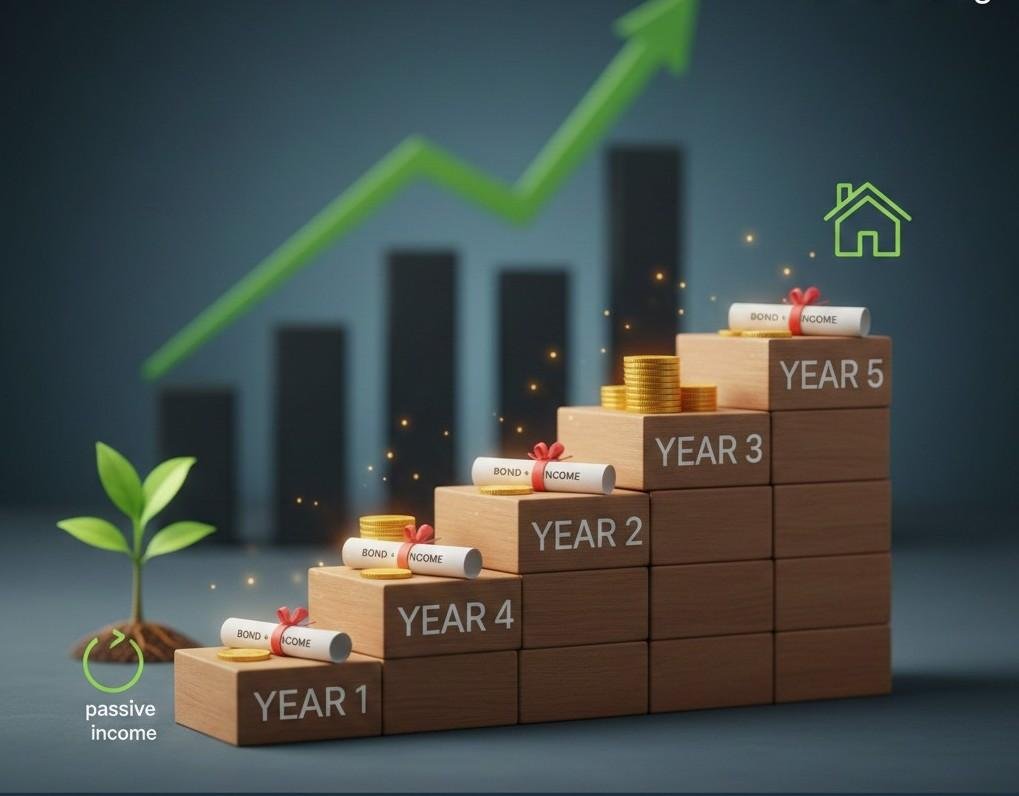
Instead of buying one $10,000 bond that matures in 10 years, you buy five $2,000 bonds maturing in 2, 4, 6, 8, and 10 years. As each one matures, you reinvest the money at current market rates. This protects you from getting “stuck” in a low-interest-rate environment.
Bond Funds and ETFs
For most individual investors, buying individual bonds is expensive and complex. Bond ETFs (Exchange Traded Funds) allow you to own a basket of hundreds of bonds for a very low fee, providing instant diversification.
7. Common Pitfalls to Avoid
- Chasing Yield: Don’t buy a bond just because it offers 10% interest. Usually, a high yield means a high risk of losing your entire investment.
- Ignoring Inflation: If your bond pays 4% but inflation is 5%, you are technically losing purchasing power.
- Lack of Liquidity: Some “Muni” bonds can be hard to sell quickly if you need cash.
8. Conclusion: Building Your Income Stream
Understanding the basics of bond investing for income is the first step toward financial independence. By balancing the growth of stocks with the reliability of fixed income, you create a “weather-proof” portfolio that can survive any economic cycle.
Remember, the goal of a guide to fixed-income investments isn’t just to teach you how to save—it’s to teach you how to make your money work for you, providing a steady stream of income while you sleep.
Below is a breakdown of how a $50,000 investment would look when structured as a 5-year ladder.
The $50,000 “Income Stream” Bond Ladder
In this scenario, we divide your $50,000 into five equal “rungs” of $10,000 each. Each rung is a bond (or Bond ETF) with a different maturity date.
Bond Ladder Example Table
| Rung | Investment Amount | Maturity Term | Estimated Annual Yield | Annual Income | Maturity Year |
| 1 | $10,000 | 1 Year | 4.5% | $450 | Year 1 |
| 2 | $10,000 | 2 Years | 4.2% | $420 | Year 2 |
| 3 | $10,000 | 3 Years | 4.0% | $400 | Year 3 |
| 4 | $10,000 | 4 Years | 4.1% | $410 | Year 4 |
| 5 | $10,000 | 5 Years | 4.3% | $430 | Year 5 |
| Total | $50,000 | — | Avg: 4.22% | $2,110 | — |
How the Strategy Works in Practice:
- Year 1 Ends: Your first $10,000 bond matures. You now have your original $10,000 back plus the $450 in interest you earned throughout the year.
- The Reinvestment: You take that $10,000 and “move it to the top of the ladder” by buying a new 5-year bond.
- The Benefit: If interest rates have risen during that year, your new 5-year bond will likely pay a higher coupon than your old 1-year bond did. If rates have fallen, you still have four other bonds locked in at older, higher rates.
Why This Beats a Single Bond:
- Liquidity: You have $10,000 becoming liquid every single year. You are never “locked away” from all your money for a decade.
- Averaging: You are essentially “dollar-cost averaging” into interest rates. You don’t have to guess whether rates will go up or down; you simply reinvest as you go.
- Stability: This setup creates a consistent, predictable flow of $2,110 per year (based on the table above) that you can either spend or reinvest to grow the principal.
Conclusion: Turning Knowledge Into Income
Mastering the basics of bond investing for income is about moving from a “saver” mindset to a “strategist” mindset. By implementing a guide to fixed-income investments—like the bond ladder we discussed—you stop being a victim of market volatility and start becoming the architect of your own financial stability.
Bonds may not have the “glamour” of high-flying tech stocks, but they offer something far more valuable for the long-term investor: peace of mind. Whether the stock market is soaring or sliding, a well-structured bond portfolio ensures that your “paycheck” keeps arriving on time, every time.
Now is the time to look at your portfolio. Are you over-exposed to risk? Could a steady stream of interest payments help you reach your goals faster? Start small, build your rungs, and watch your passive income grow.
Frequently Asked Questions (FAQ)
1. Are bonds safer than stocks?
Generally, yes. Bonds are considered less volatile because they are a debt obligation. If a company goes bankrupt, bondholders are paid back before stockholders. However, no investment is 100% risk-free; bonds still carry interest rate and inflation risks.
2. Can I lose money in bond investing?
Yes. While you get your principal back if you hold a bond to maturity, the market value of the bond can drop if interest rates rise. If you sell the bond before it matures during a high-rate environment, you may sell it for less than you paid.
3. What is the difference between a bond’s “Coupon” and its “Yield”?
The Coupon is the fixed interest rate set when the bond is issued (e.g., 4%). The Yield is your actual return based on the current market price. If you buy a bond at a discount, your yield will be higher than the coupon rate.
4. How often do bonds pay interest?
Most bonds pay interest semi-annually (twice a year), though some monthly-pay bond ETFs exist for investors who need more frequent cash flow.
5. Do I need a lot of money to start bond investing?
Not anymore. While individual corporate or municipal bonds often require $1,000 to $5,000 minimums, you can invest in a Bond ETF for the price of a single share (often under $100), giving you instant exposure to thousands of different bonds.
Read more
- Digital India: Identify Your Land Survey Number Instantly Using Your Smartphone
- AI in Farming: How Indian Farmers Are Transforming Agriculture
- Best Winter Crops for Export From India
- Dhaincha Farming Guide: Save 50% on Urea & Improve Soil Health
- Fertilizer Booking App Guide: How to Book Urea Online


